Saturday, 21 January 2012

"But there was nothing chiselled about it. In fact, it consisted of stones stacked one atop the other. Time had since taken care of binding and cementing them, camouflaging them with dust, earth, seeping water and saltpetre, finally transforming the rough surface into an almost natural wall." ("The Terracotta Dog" Andrea Camilleri transl. by Stephen Sartarelli)


Mid January and we are at the "house in progress".  Peter wants to climb the scaffolding to check the depth of the insulation in the roof, like some inspector from the grants department of a London borough.  He steps onto the scaffolding and even before his full weight is on it, the metal structure creaks and wobbles.  Whatever he finds up there, I'll take his word for it.
Heedless of this, on another part of the roof, Alessandro (our Michelangelo) is acting out a scene for a comedy film with intermittent fast forward (or so it seems to me at ground level).  First we see him pacing leisurely along a barren slope of the roof.  Suddenly he calls down below for some bricks.  The bricks appear on the roof beside him. 
Fast forward, Alessandro is placing the bricks wildly into a pile. 


Change of pace, he calls down to anyone within earshot: Does that look ok?  Someone calls back: No, take that yellow brick there, yeh, that one, and swop it for that bigger one in the other corner.  


Fast forward, Alessandro is juggling bricks again.  Then he stops, no more questions.  He just stands back and right there on top of the roof he leans against his brick structure (with more confidence than seems wise), hand rolls a cigarette, lights it, then blows thin strands of smoke into the the gentle breeze.  We ask a fellow worker what's going on:  Oh, Sandro has just built a chimney!  Of course, stupid question, as would be:  is it in the right place; is it the right size/ shape; will it work; will it stand the test of time?  I raise a hand up to Alessandro:  Nice chimney Alex!  He smiles, flings his cigarette butt down onto the earth below and wanders off casually to another part of the roof.  In the plans, the house has two chimneys.


The roof is near completion, and if the fine weather holds, work will soon start on the foundations of the kitchen.  This lies to the north west side of the house, it is part of the original building , but had to be demolished at the outset of restructuring as it was completely unstable.  The exterior walls of the new kitchen will not have the stone "faccia vista" of the rest of the house and will be stucco'd (as opposed to rendered and painted).  Our next big hurdle will be to decide which colour "stucco" and ...will our choice meet Paolo's (our geometra) approval?


Wednesday, 11 January 2012

“Time has no divisions to mark its passage, there is never a thunderstorm or a blare of trumpets to announce the beginning of a new month or year ... it is only we mortals who ring bells and fire off pistols”. (“The Magic Mountain” Thomas Mann)


And so the festivities are over, the sky is a clear blue and the sun warm enough to sit outside and enjoy a morning coffee.
Christmas was heralded in Corinaldo (just inland from the coast) with an impressive flag waving ceremony and a somewhat alarming fanfare of fireworks, set off in the town’s smallest square with its densest crowd of the year.  No harm done really, though one woman’s hair was singed.
Back to Corinaldo on Christmas day with our two eldest sons, who had managed to fly out for a few days; our youngest  at work in London in a 2* Michelin restaurant.  We, however, were booked into a restaurant carved into the fortress walls of this town.  An Antipasto of 5 separate dishes; primi piatti of 3 dishes including the Christmas special of gorgeous cappelletti in brodo; secondi piatti of 3 different meat dishes with contorni of vegetables and salad; dessert of fresh cream cake and pannettone, followed by a basket of fresh fruit, coffee and a glass of bubbly.  There were 3 bottles of local wine on the table and a generous “digestivo” of limoncello to complete and complement the meal which was quite excellent.  Not, perhaps, Michelin star, but then neither was the all inclusive price of 35 euros per person.  Three and a half hours later we walked into the sunshine and took a short walk around the historic town, quite deserted.
Between Christmas and New Year I went into the local hospital for three days to undergo a planned minor operation.  Is this experience different from the NHS?  Oh yes, in a myriad of minor ways, mostly to do with culture, family concern and common sense - a lot more of all three here.  But essentially it’s the same - you go in naive and nervous and come out bruised and baffled.  Feeling fine now.
New Year here is celebrated with a special meal on the eve and the inevitable fireworks at midnight.  We stepped outside to watch every little town, as far as our pivotal horizon could encompass, compete with a magnificent starry sky.  Surprisingly, the air the following morning is fresh and clear and the church bells are pealing, louder and more sonorous, it seems, this morning.
The Italian newscast tells another story of damage to property, life and limb around the country, caused by “careless” (euphemism) use of fireworks.  Essentially, much the same as “news” in England every November 6th.
Peter and I have completed our celebrations by visiting our “ruin” - now very much a “house in the making” !  Here are some photos of the new roof, minus the "coppi" roof tiles still to be laid, with perhaps a glimpse of that no.15 wood stain and the rather shiny new copper guttering.  A start has been made in grouting the stone "faccia vista".  The “Atto” has been signed, taxes paid to the commune, we are officially “established”!  We have great hopes for 2012, can, almost, hear that blare of heavenly trumpets.


Wednesday, 21 December 2011

“The snow above was too hard and cold to fall; if you could shake heaven tonight, it would rattle like a cradle toy.” (“Fludd” - Hilary Mantel)


The French have been telling tales out of school about the British in the last week.  It surprised me that this traditional anglo-french badinage did not include the well known fact that all the anglos ever talk about is the weather.  Surprising, because this has been much on my mind recently.  Live in Le Marche for a while and you will realise that the Brits do not have a monopoly over the weather.  I cannot recall any conversation with any Italian, or overheard any conversation, where the weather has not been mentioned.  From every stall holder in the market, to every barista , hairdresser, shopkeeper, farmer, dog walker, restaurant-goer, builder, candlestick-maker, the weather is a “topic”.  Whether it rains or shines, is windy or calm, is warm or cold, is threatening to snow or not, it is all of particular and peculiar interest; peculiar because nothing quite like this, all of it, has been known for twenty years or more.  Has the weather in Italy been hibernating for the last two decades?
Now here’s the rub... when Italians talk about the weather it is sensational, definitely “different” and definitely worthy of elaborate and “interesting” discussion.  Whereas the weather in Great Britain is boring, mundane, monotonous, un-noteworthy, quite unremarkable really.  Therefore any conversation about the weather in Great Britain is equally boring and all those other derogatory things.  Dare I offer some advice to my fellow countrymen - hold your head up high, talk about the weather with gusto, be proud of it, be amazed by it, rejoice in its Britishness.  Learn from the Italians - it’s not what you say;  it’s the way that you say it! 
This evening we went to have a pizza at an eatery called “Piccolo Ranch” in a little town further up the valley from our “ruin”.  The restaurant, though large, is unimposing.  The welcome is warm - the padrone dressed formally in black; the waitresses brisk; the tables covered in paper.  The atmosphere might have been something of  a roadside cafe trying harder, if it weren’t for the walls.  They were covered in trompe d’oeil murals of idyllic pastoral scenes viewed through painted portals of intricately carved stone.  The perspective a bit awry, the colours unconvincing, altogether a bit kitsch, but with a squint offered a promise of the palatial.
The pizzas, however, were perfect.  Promptly served, more than a generous size, with a thin and crispy base you could almost see through, and charred at the edges.  That kind of charring effect for which pyrotechnic children spend whole afternoons with a box of matches ageing paper from A4 blocks, attempting to emulate the effect of a pirate treasure map and succeeding in creating something close to convincing out of the tablecloth or the rug.
The customer turnover is faster here than I’ve seen for a while.  In the foyer on our way out the elderly padrone, now in shirtsleeves, with a large bright scarf draped flamboyantly over his shoulders exclaimed, “Oh, you are English!” (in English!) as if we’d just landed from Mars.  He had clearly been enjoying some of his own excellent house wine and he called all his friends (anyone else he could find in the foyer) to witness his “find”.  We stood, surrounded by the murals, graciously smiling at each other, each with our own perspective.
When we got outside, how do I put this... it had started to snow.  BUON NATALE A TUTTI !


Sunday, 11 December 2011

“On such snow as this, said he, ‘he won’t go far, for he is a fat bear. He will settle down before evening; or if not, I can overtake him on snowshoes.’ “ (from an autobiographical account of a bear hunt undertaken by the young Leo Tolstoy).


Without fanfare, Italy has passed a new law.  It decrees that all vehicles must carry snow chains when traveling on designated roads.  Failure to do so carries a fine.  These roads have blue signs depicting a tyre covered by a snow chain: pretty clear.  Some, but not all,  of these signs give the the months when this requirement is effective:  novembre - aprile.  Peter has, by chance, got chains in the Land Rover, but, currently, I am driving around illegally in the Honda.
Snow chains we are told, “cannot be had for love nor money”; one of the more publishable phrases we have heard describing this “crisis”.  There has been a run on snow chains!  Italians have been stocking up on snow chains!  We have visited any number of outlets likely to sell chains.  Some salespeople dismiss our request almost before it is uttered; some sympathise; others philosophise; some take our telephone number promising to ‘phone if a delivery arrives before Christmas.  Then there are those equally frustrated customers, each with his own sorrowful (and lengthy) tale, including the obliging gentleman who discreetly followed us out to our car to advise us to request a written attestation of the total unavailability of snow chains signed by the “gommista” (tyre fitter) so that when we are stopped by the carabinieri, we can prove we tried to buy chains.  All of this had the same effect on us - helplessness.
Last night, whilst out for cocktails with Paolo, Peter took the opportunity to talk, as one does, about snow chains.  Yes, Paolo had bought himself a set that very day!  But where?   When he tells us, we realise it is the Agip station we have already tried, and they didn’t have the right size for our tyres.  (Although at this stage that hardly seems an important criteria, if it ever was).  I asked Paolo how many times in his life had he used snow chains.  “Mai” (never), this in his most matter of fact tone.  What a relief!  The thought of trying to fit snow chains to my car has the same effect on me as that of me trying to change a tyre - helplessness (sorry, girls).  Now, where around here do you think they might sell snow shoes?
Oh, the cocktails were to celebrate the Commune’s decision to approve the plans for our “project” in its entirety.  We will be signing the final contract (Atto) before the year end.  After that there’s no going back.
I should add that, towards the end of his life, Tolstoy greatly regretted ever having hunted that bear.

Wednesday, 7 December 2011

“But I am sure I have always thought of Christmas time when it has come around - apart from the veneration due to its origin, if anything belonging to it can be apart from that - as a good time; a kind, forgiving, charitable, pleasant time: the only time I know of, in the long calendar of the year, when men and women seem by one consent to open their shut-up hearts freely, and to think of people below them as if they really were fellow passengers to the grave, and not another race of creatures bound on other journeys.” (Scrooge’s nephew from “A Christmas Carol” Dickens).


I was reading some Dickens with my english pupil (more of that another time).  Dickens is good, sometimes he’s better, but never does he dodge an issue.
We have a roof!  Well, sort of.  A start has been made on putting up the massive oak beams that will support all the ceilings of the house .  They hope to finish the whole of the roof by Christmas - anything’s possible.  Alessandro hops, skips and jumps across the narrow cross beams.  His only tools an electric chainsaw, his hands, and his eyes.  One fellow props up a beam, Alessandro puts it in place, then saws off the ends to fit - all done by eye.  I have to say, looking at them, they all seem accurately placed and of equal length, I think. (Oh, ye of little faith). 


Paulo arranged an appointment for us with the owner of a builder’s yard where we were to choose the colour of the wood stain for the beams.  After having spent half a day trying to find the place, we were cordially greeted and proudly presented with a special display from which to make our choice.  First, there was the well worn colour chart, but only 4 of those colours were displayed on actual wood samples and, of those 4, two were no longer available (since when, I wondered pointlessly).  This chap was making good use of the knowledge that less choice helps the customer choose.  We took our time, looking at the samples in different lights and from different angles, extolling the virtues of each colour: its depth and shade and suitability for our type of house and our particular taste (we didn’t want the chap to feel we didn’t appreciate the effort he had gone to on our account).  We chose no. 15.  How do I describe it?  It’s kind of - brown.   A roof by Christmas, our present wrapped: a hop, skip and jump of faith.
One day last week we were walking the dogs along our usual stretch of road (“strada bianca”, as they call the unmade roads here), when we came across two farmers loading sacks of seed into a hopper at the back of their tractor.  The older of the two men took the opportunity to stop work and chat, allowing the younger to continue lifting and emptying the heavy sacks.  Pete and the farmer chatted (I nodded and smiled at what I hoped were appropriate moments) about the weather - 2 days of rain in the last 3 months, no rain at all by the coast since June; the benefits of sowing corn (as opposed to ?) this season; the price of tractor fuel.  The older man complained about the quality of the soil, the difficulty of farming this hilly terrain, the lack of rain, the scanty yield, the market price for the crop; farmer’s talk the world over, time for a nod and a smile.  Pete said, “We like it here”, the farmer replied with a smile, “This is land cursed by God”.  There was a harvest of innuendo in that smile, I can imagine Dickens’ Jack Hawkins (the artful dodger) smiling just like that, except the farmer’s hat sat firmly on his head.
That same evening we had one of those sunsets that says “Italy” to me.  A bank of cloud formed over Monte Catria on the distant horizon; a promise of rain that never came. Shards of light broke through intermittent breaks in the cloud;  beatific.  Someone else was smiling.

Tuesday, 29 November 2011

On seeing Michelangelo at work in St. Peter's, Rome in the mid 1500's, one French traveller recorded: "It has to be seen to be believed. He went at it with such fury and impetuosity that I thought the whole work would be knocked to pieces. He struck off with one blow chips three or four inches thick so close to the mark that, if he had gone just a fraction beyond, he would have ruined the entire work." (publ. "Rome", Christopher Hibbert)


The sun is shining today in a clear blue sky, same as yesterday.  In the sun it is warm, but in the shadows there is the first morning frost.  Last week it did rain for a day or two, sufficient to soak the pale, cloying clay of the soil here.  It is ploughed with heavy machinery and turns over in solid boulders which have to be worked again and again - like kneading dough - the kind I make.  We visited our "site" where the mud adhered to our boots and took hold, piling on with each step like concrete (in another story death by drowning would be guaranteed).  There is no way of getting the mud off.  We tried scraping, stamping, swearing, nothing worked.  This is the stuff from which they make building bricks around here.
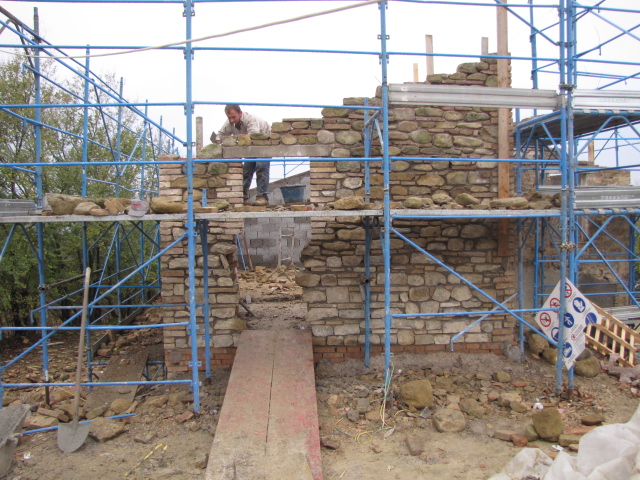
The walls of our ruin were, however, originally made of stone.  Each of which is being individually cleaned and, where necessary, replaced and re-fashioned by Alessandro, the stonemason.  He is a master of his craft.  Peter has nicknamed him Michelangelo.  An exaggeration perhaps?  Alessandro is different - less temperamental for a start.  Italy today is still a land of master artisans.  It seeps through all trades.  Everyone (there are exceptions, of course!) seems to take pride in their work, even in the service industries.  All aspiring entrepreneurs would do well to apprentice here.  Here are some photos of men at work, no hard hats in sight.


Today we went to Serra de Conti for the Cicerchia Festival.  Cicerchia are like chick peas, once a peasants staple, now revived as a gourmet delicacy for those in the know.  The streets with their steep, paved stairwells and cluttered piazzas are thronged with visitors for the festival.  All doorways open to makeshift restaurants serving a variety of dishes all containing Cicerchia and all tables fully booked.  On every corner of every little piazza an untended, open log fire blazes ineffectually in the chill of the shadows.  The fires have no guards, people old and young brush by the flames regardless.
The little town of Serra de Conti is famous throughout Italy for this festival.  it may be Sunday but all the shops are open, many selling locally crafted jewellery, pottery and macramé.  Generous samples of local wines, cheeses (and onions!) are on offer and their stalls signposted by cheerful, if disorderly, queues.  The Town Hall has graciously opened its doors to all, with an art and poetry exhibition and, in one little room almost obscured from view, a sole exhibit of a massive, old, cumbersome cinema projector (though not as old as the one used in "Il Nuovo Cinema Paradiso", the iconic, must see film set in 1950's Sicily).  In the main square young children in makeshift costumes were preparing to stage a dramatic performance, ignoring the one little donkey standing forlornly close by.  Donkey and owner were presumably, though not obviously, awaiting takers for a four legged tour of the town;  presumably, but not necessarily, on a route avoiding all the vertiginous stairwells.

Lack of foresight, no doubt fuelled by our ignorance of the allure of Cicerchia, meant we hadn't booked a table anywhere in town and consequently didn't get to taste it (the Cicerchia, that is).  But reasons for not buying a packet of the dried out pulse, at what looked like Festival prices, from one of the eager bancarellisti (lovely word!) lining the ever narrowing passageways, elude me.


Sunday, 20 November 2011

"But when the slates came off extravagant Sky entered and held surprise wide open". (from "Glenmore Revisited" Seamus Heaney)

Days after celebrating 150 years of the unification of their country, the Italians are again flying their flags for the final fall (they hope) of Berlusconi; perhaps like Garibaldi, they'll name a biscuit after him too - fruitier, but less tasty.

We have finally got wi-fi installed in the apartment and here are some photos showing the progress on our house. No front wall and no roof! Although a new interior wall has been built to the first floor and, importantly, within it an original wooden beam has been carefully replaced; it does not look out of place, it's a little lopsided.

One evening last week we were invited to Paolo's house for a celebratory tasting of this year's newly pressed olive oil. Fifteen or so guests seated around a linen covered banqueting table with a wood fire blazing, "help" in the kitchen, and all the courses,starting with polenta and porcini, basked in olive oil. This virgin olive oil is unlike anything Peter and I have ever tasted before. In the bottle it is pale green and cloudy, like grape flesh. Its taste is not at all oily, subtle and slightly bitter. It is treated at table with the reverence afforded a vintage wine.

After the the meal Paolo gave us a proud tour of his house. He not only built it himself, he also precisely chose everything in it from floor tiles to doors to furniture to bath taps, each detail savouring the "rustic" flavour of the original building and of the traditions of the region. He repeats: Of course you can choose anything you like for your house", but this is just rhetoric, we know that, in his view, nothing will be right unless it replicates his vision of the "rustic". His house is a sound premise for his point.

The next day we went back to our man with the red rimmed spectacles, Ricardo (no really, you can't make up alliteration like that). We have to pay the bill for the wi-fi installation. We are invited again to sample "The best coffee in all of Italy" which today comes with a lecture on the production and appreciation of olive oil. Whilst Paolo may be his good friend, Ricardo is not shy of hinting at criticism of his olive oil making methods, nor of its resulting quality, not to mention the consistency of its shelf life. We quickly realise that there is a chauvinism amongst olive oil producers second only to that of "viticoltori" of DOC labelled wines.

As one guest at Paolo's table said: The three most important things to Italians are family, food and fashion (the fourth is women), not always in that order. Flying the flag, it seems, lags way behind in the order of priorities.